
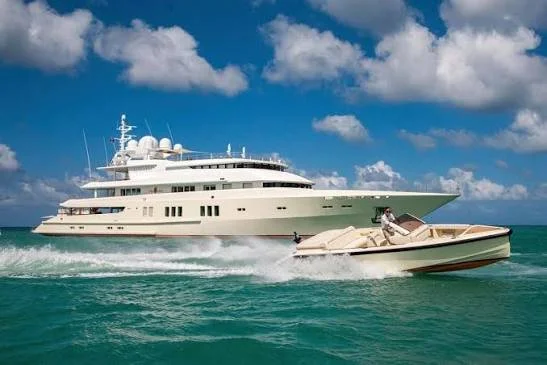
He Bought a $50M Yacht, Spent €35M Rebuilding It—
and Now Wants €99M
The numbers behind Ian Malouf’s 73-meter Coral Ocean show why purchase price, refit investment, charter revenue and asking price reveal only part of a yacht’s economic return.
A yacht reportedly acquired for about $50 million is now offered at €99 million after a €35 million rebuild. On paper, that can resemble an enormous gain. The actual economics of owning Coral Ocean are far more complicated.
Australian entrepreneur and Ahoy Club founder Ian Malouf has reportedly placed a four-yacht fleet on the market. The portfolio includes the 73-meter Coral Ocean, 54-meter Mischief, 35-meter Rascal and 30-meter Chaos.
The Coral Ocean headline numbers
Coral Ocean was delivered by Lürssen in 1994 as Coral Island. Malouf acquired the yacht in 2019 and later undertook an extensive transformation. Australian reporting has placed the acquisition near $50 million, while Ahoy Club describes a €35 million hull-to-helm rebuild completed in 2022.
The project reportedly reconstructed upper-deck areas, transformed interiors and redesigned guest spaces, adding approximately 150 gross tons. Additional 2026 work reportedly included the vessel’s 30-year survey and new stabilizers. The yacht is scheduled to appear at the 2026 Monaco Yacht Show, running September 23–26.
Did the owner make money?
There is not enough public information to answer reliably. Subtracting a reported purchase price and refit budget from the current asking price ignores much of the ownership ledger—and mixes U.S. dollars with euros without accounting for exchange rates or timing.
| Economic component | Why it matters | Publicly known? |
|---|---|---|
| Acquisition and closing | Purchase, legal, survey, financing, registration and professional fees | Only a reported headline purchase figure |
| Refits and capital work | May preserve value, extend life or improve charter competitiveness | A €35 million rebuild is reported |
| Annual operations | Years of payroll, fuel, insurance, maintenance and management | Not publicly available |
| Charter contribution | Revenue less commissions and charter-related costs | Advertised rates, not owner profit |
| Exit proceeds | Closing price less selling and tax costs | No—€99 million is an asking price |
Acquisition cost is more than the purchase price
Surveys, technical inspections, legal work, registration, financing and professional fees all add to capital committed at closing. These expenditures rarely appear beside a headline price but belong in the ownership analysis.
The €35 million rebuild is capital deployed
The relevant question is not merely what the refit cost. It is whether the investment increased market value, charter earning capacity, useful life, owner enjoyment—or a combination of those outcomes.
Then come years of operating costs
For a 73-meter, 1,500-plus-GT yacht, annual expenditure may include crew and employment costs, fuel, insurance, dockage, maintenance, classification, management, provisions, communications, tenders, surveys and further capital projects.
Coral Ocean’s actual annual costs are not public. That missing figure is essential: years of operation can absorb a meaningful portion of apparent appreciation even when a yacht later sells above its original purchase price.
Charter revenue changes—but does not complete—the picture
Coral Ocean has operated as a commercially registered charter yacht. Current published listings reportedly begin near €650,000 per week, with some high-season rates reaching €790,000. Advertised rates are gross billings, not owner profit.
| Illustrative charter weeks | Gross billings at €650,000/week |
|---|---|
| 5 weeks | €3.25 million |
| 8 weeks | €5.20 million |
| 10 weeks | €6.50 million |
| 12 weeks | €7.80 million |
Broker commissions, management, positioning, maintenance, taxes and charter-specific expenses reduce what the owner retains. The useful measure is the yacht’s net economic contribution from charter activity, not its advertised weekly rate.
A €99 million asking price is not a €99 million sale
The yacht has not been reported sold at €99 million. Until a transaction closes, that number remains an asking price. Even a completed sale at that level would be reduced by brokerage, legal, closing and potentially tax costs, depending on ownership, use, jurisdiction and transaction structure.
When does a major refit make economic sense?
Coral Ocean was already about 25 years old when acquired in 2019. Rather than immediately commissioning a new yacht, ownership invested in transforming an existing Lürssen while preserving its pedigree and Jon Bannenberg design.
- Separate preservation from enhancement. Some work maintains safety, class and saleability rather than creating new value.
- Measure charter impact. Guest spaces and amenities may improve rate, demand or utilization, but only net contribution matters.
- Model useful-life extension. Technical investment may defer replacement and support additional operating years.
- Track owner-enjoyment projects separately. A project can be worthwhile without producing a measurable financial return.
- Forecast the exit. Compare likely resale value with capital invested and all incremental ownership costs.
Malouf is marketing a four-yacht fleet
The scale of the offering is unusual. Ahoy Club has reportedly listed four yachts exclusively, describing roughly €150 million of owned superyacht stock entering the market.
| Yacht | Builder / length | Reported asking price |
|---|---|---|
| Coral Ocean | Lürssen · 73m | €99 million |
| Mischief | Baglietto · 54m | €19.99 million |
| Rascal | Sunseeker · 35m | €6.59 million |
| Chaos | Sunseeker · 30m | €2.99 million |
Malouf has reportedly said the sale is not an exit from yacht ownership and that he is considering a larger yacht suited to extended world cruising. The cycle is therefore better described as: acquire, invest, operate, charter, refit, sell and reinvest.
What Coral Ocean shows about yacht ownership
The public figures are extraordinary: a reported acquisition around $50 million, a €35 million rebuild, a charter rate beginning near €650,000 a week and a €99 million asking price. None independently proves profitability.
A reliable analysis needs the complete ledger: acquisition basis, capital projects, operations, charter revenue and related costs, financing, taxes, selling expenses and final net proceeds. Strategic refits and charter activity can offset ownership cost, while years of spending can consume apparent appreciation.
McGregor Financial Services helps yacht owners connect acquisition basis, capital expenditure, charter economics, entity accounting and tax planning. Explore MFS financial administration for yachts, yacht tax advisory and yachting accountant resources.
Sources and attribution
This analysis uses publicly reported acquisition, rebuild, charter and asking-price figures attributed to Ahoy Club, Australian reporting, refit coverage and SuperYacht Times. Actual ownership costs, charter performance, tax treatment and transaction economics are not public and may differ materially.